Visitor Management in Hospitals: Why Healthcare Facilities Need More Than a Front Desk
Hospitals are unlike any other facility in the world. They operate around the clock, welcome thousands of people through their doors every single day, and carry a responsibility that goes far beyond any other organisation. Patients are vulnerable. Staff are stretched. And the stakes of a security lapse or an administrative failure are not just operational, they can be deeply personal and even dangerous.
Yet, walk into many hospitals today and you will still find the same reception setup that has existed for decades. A harried receptionist, a paper visitor log, a waiting area full of people with no one clearly managing who has come in, who is allowed through, and who should not be there at all. It is a system built for a simpler time, and it is no longer enough.
The Volume Problem: Who Is Actually Walking Through Your Doors?
No other institution manages the same complexity of foot traffic as a hospital. On any given day, a large facility receives patients, their families, vendors, maintenance crews, consultants, volunteers, and staff across dozens of departments. Each of these groups has different levels of access, different reasons for being there, and different risks associated with their presence.
Traditional front desks were never designed to handle this. A receptionist can only do so much. They cannot simultaneously greet a new arrival, verify a visitor’s identity, notify the relevant ward, monitor who has checked out, and flag someone who should not be on the premises.
Why Paper Logs Are a Liability, Not a System
Paper logs are easy to falsify, impossible to analyse in real time, and provide no accountability once a visitor has walked past the desk. The consequences of poor visitor management in hospitals are serious. Unauthorised individuals in sensitive wards create psychological distress for patients. Infections spread when access to isolation zones is not properly controlled. Incidents involving unvetted visitors put staff at risk. And in a regulatory environment that increasingly demands documented compliance, a paper log simply does not hold up.
Why a Digital Visitor Management System Changes Everything
A purpose-built digital visitor management system addresses each of these problems in a way that no manual process can. piLOBI is designed specifically for environments that demand security, speed, and accountability, and its application in healthcare settings demonstrates exactly why the shift from paper to digital is not just a convenience but a necessity.
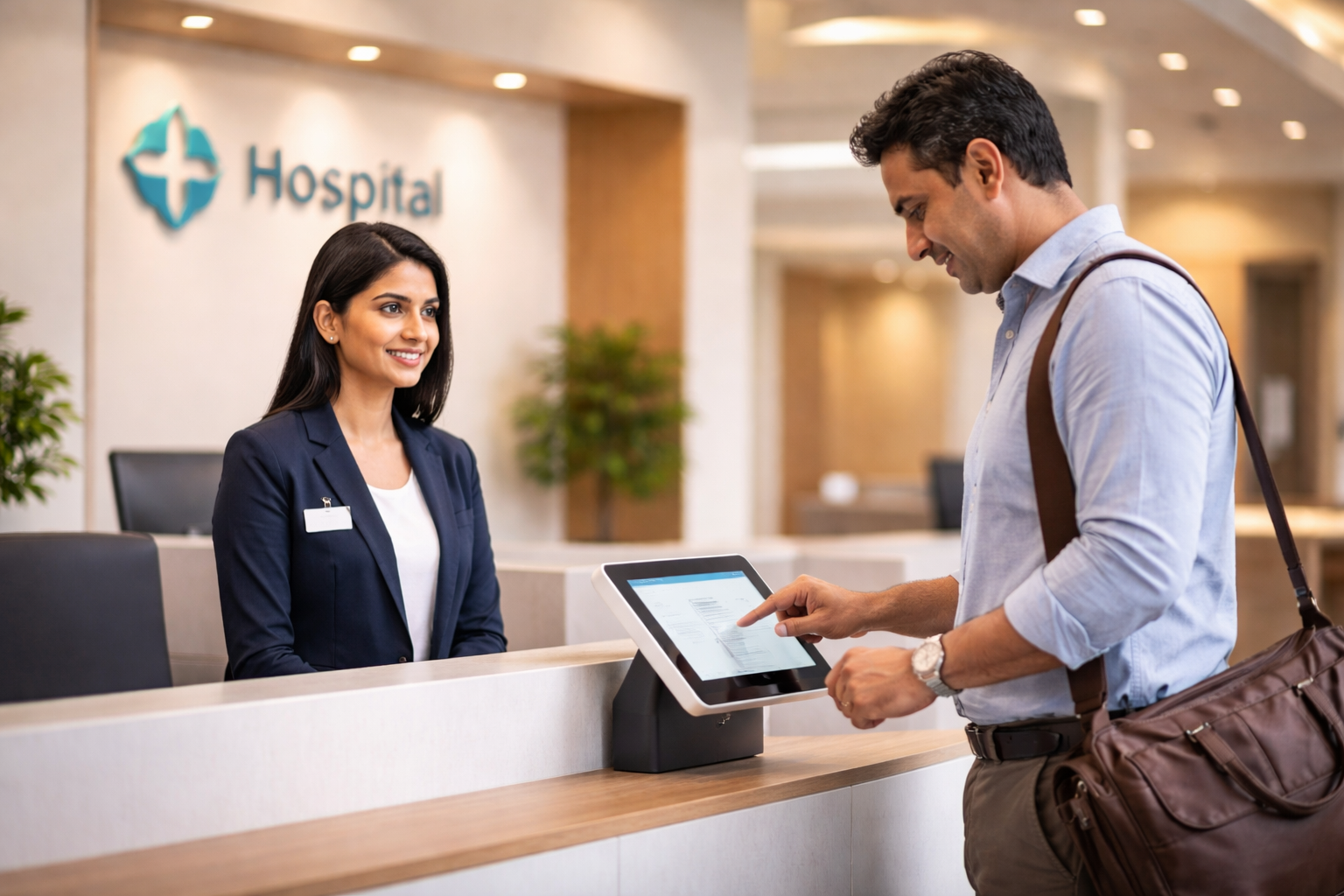
The moment a visitor arrives at a piLOBI-enabled facility, the process becomes structured and traceable. Self-service check-in means visitors register themselves quickly without placing additional burden on reception staff. The system captures facial photographs and digital signatures at the point of entry, creating a verified, cloud-stored record of every individual who has passed through. This is not a minor upgrade. It is a fundamental shift in how a hospital knows who is inside its walls at any given moment.
Giving Staff Their Time Back
One of the most underappreciated benefits of a digital reception system in a hospital is the relief it provides to frontline staff. Nurses, ward administrators, and receptionists are already managing enormous workloads. Every minute spent manually logging a visitor, searching for a contact number, or trying to locate a patient’s family member is a minute taken away from patient care.
piLOBI automates the entire visitor registration process. Once a visitor checks in, the system instantly sends a real-time notification to the relevant host, whether that is a ward nurse, a doctor, or a department coordinator. There is no phone call needed, no running to find someone, no delay. The host is informed immediately, and the visitor’s arrival is logged without any manual intervention.
Knowing Who Goes Where: The Access Control Imperative
Not every visitor should have access to every part of a hospital. Intensive care units, neonatal wards, and oncology departments have visitor restrictions that exist for very good reasons. Managing these restrictions manually relies entirely on staff remembering who is allowed where, which is an unreliable system under the best of circumstances.
Verified Identities and Visitor Badges That Mean Something
With piLOBI, visitor access is documented and restricted at the point of entry. The system maintains a database of visitor credentials and visit history, making it possible to identify repeat visitors, flag unusual patterns, and ensure that only authorised individuals reach sensitive areas. Visitor badges issued through the system provide a visible, physical marker of who has been cleared to be in the building, making it easier for staff to identify anyone who should not be in a particular zone.
Facial image capture adds another layer entirely. Unlike a signed paper form, a photograph cannot be disputed or forged after the fact. It creates an immediate, verifiable record that sits in the cloud and is accessible whenever it is needed.
Managing Multiple Campuses Without Losing Oversight
For hospital groups and healthcare networks operating across multiple campuses, visitor management becomes even more complex. piLOBI’s multi-location capability allows administrators to centralise oversight across all sites from a single account. A group’s security team or compliance officer can monitor visitor data across every facility in real time, ensuring consistent standards are applied everywhere without requiring separate systems or reporting processes at each location.
Works Across Devices, Adapts to Your Environment
piLOBI runs on both Android and iOS, meaning it is not dependent on a single hardware setup or a fixed reception terminal. Hospitals with different configurations across wards and entry points can deploy the system flexibly, without the cost or friction of a complete infrastructure overhaul. It is built to fit the environment, not the other way around.
From Reactive to Proactive: A Smarter Security Posture
Perhaps the most important change a system like piLOBI brings to a hospital is the shift from reactive to proactive security. Traditional front desks deal with problems after they arise. Someone gets into a ward they should not have, and staff investigate after the fact. A visitor is flagged as a concern, and there is no record to refer to.
A digital visitor management system means that the information is there before anything goes wrong. Access is controlled before a visitor reaches a restricted area, not after. And when something does need to be investigated, there is a complete, verifiable record to work from.
The Front Desk Is a Starting Point, Not a Solution
A front desk will always play a role in a hospital’s operations. But relying on it as the primary mechanism for visitor security and management is no longer viable in a modern healthcare environment. The volume of visitors is too high, the stakes are too significant, and the complexity is too great for any manual system to handle reliably.
piLOBI exists precisely for this gap. It is fast, secure, and built to handle the real-world demands of high-traffic healthcare facilities. For hospitals that take the safety of their patients, staff, and premises seriously, it is not a question of whether to upgrade the visitor management process. It is a question of how soon.
To learn more about how piLOBI works for hospitals, visit pilobi.com.
Related Posts

The Hidden Operational Costs of Manual Visitor Management in Offices
Many offices still rely on traditional visitor registers to track guests entering their premises. At...

Importance of School Visitor Management System and its Features
In today’s educational scenario, ensuring the safety and security of students, staff and visitors...

The Top 7 Skills Every Receptionist Should Master in 2024
The receptionist is typically the first person you see when entering an office. They...